Some of the best things to do in Old Louisville cost nothing at all. The historic neighborhood just south of downtown is packed with sights and points of interest you can enjoy for free or very little.
One of the largest historic preservation districts in the country, Old Louisville has more than a thousand old homes, constructed primarily between 1880 and 1905. Châteauesque, Richardsonian-Romanesque, Italianate, Victorian Gothic, and Queen Anne all adorn Old Louisville.
If you don’t have time for a guided tour, this self-guided walking tour covers six landmarks you can see in an easy stroll of about 2 miles, roughly 60 to 90 minutes at a comfortable pace. Addresses are included with each stop. Happy sightseeing!
St James Court Fountain
St. James Court at Fountain Court
In 1883, the Southern Exposition opened to the south of what then counted as Louisville, in a wooded area known as the “Southern Extension.” City planners of the day boasted that the main building, a two-story structure which measured 600 by 900 feet, counted as the world’s largest wooden building. It was also illuminated by a new-fangled invention which kept people coming in droves: electric lighting. Dedicated to art, industry, and agriculture, as seen through the lens of cotton, the South’s most famous crop, this early world’s fair was slated to last just one hundred days. But, it proved so popular that it spread out over five years and attracted one million visitors in the end.
After the Southern Exposition closed and workmen disassembled the massive frame structure around 1887, savvy developer William Slaughter subdivided the area and converted it into a residential enclave featuring center greens, walking courts, and a fountain imported from England. This fountain is now known as the famous St. James Court Fountain.

Neighborhood residents had the original fountain recast in the 1970s, surrounding it with elegant railings from the box seats of the recently demolished Strand Theater in downtown Louisville. Today, the central feature—a sculpture of Venus rising from the sea—marks the epicenter of the neighborhood and it still survives as a symbol of Old Louisville. You can read about this iconic Louisville landmark in the 2014 novel The Fountain of St. James Court (or Portrait of the Artist as an Old Woman) by local author and New York Times bestseller Sena Jeter Naslund.
The Conrad-Caldwell House Museum
1402 St. James Court
Considered one of the best representations of Richardsonian Romanesque residential architecture in the country, imposing “Conrad’s Castle” has been open for guided tours since the 1980s when the heavily ornamented mansion officially became the Conrad-Caldwell House Museum. Constructed of Bedford limestone at a reported cost of $75,000, it housed only two families during its first half century of existence; then it became an upscale nursing home.
On the exterior, heavy rounded arches, squat columns and pillars, anchoring towers and turrets, and rusticated surfaces embody the hallmarks of this popular style employed by architect Arthur Loomis when construction began in 1893. On the inside, glowing parquet floors, millwork, and pocket doors incorporating costly and rare hardwoods provide a glimpse of how Louisville’s upper crust lived in the neighborhood’s heyday. Theophile Conrad, the man who had it built, came from France and made his fortune in the leather tanning industry. For a modest admission fee, you can tour the house five days a week; it is also available as a rental for weddings and special events.
Central Park, Louisville
1340 S. 4th Street
Once the country estate of brothers Antoine Biderman and Alfred Victor DuPont, today’s Central Park goes back to 1904, after the famed Olmsted firm, founded by landscape architect Frederick Law Olmsted, drew up plans for a public green space at the heart of a burgeoning neighborhood. Workers tore down the old mansion and the basic outlines of today’s park were established. His firm incorporated the popular Spanish mission style of architecture to design an open-air women and children’s pavilion and a gymnasium with a swimming pool in the basement.
Its nearly 17 acres comprised an important part of the famed Southern Exposition of 1883 and, at one time, visitors would find a fireproof art museum, electric trolley line, a lake for canoes and paddleboats, rollercoaster, and bike lanes. Today it is known mostly for its shady walkways and towering trees. It is also known for its spacious amphitheater, where, since the early 1960s Old Louisville has hosted the nation’s oldest free outdoor Shakespeare festival, known as Shakespeare in the Park today. The first documented production of a Shakespeare play in the park took place on July 1, 1895 when a touring company presented As You Like It in the area where the Kentucky Shakespeare Festival’s stage is now located.
The Witches’ Tree

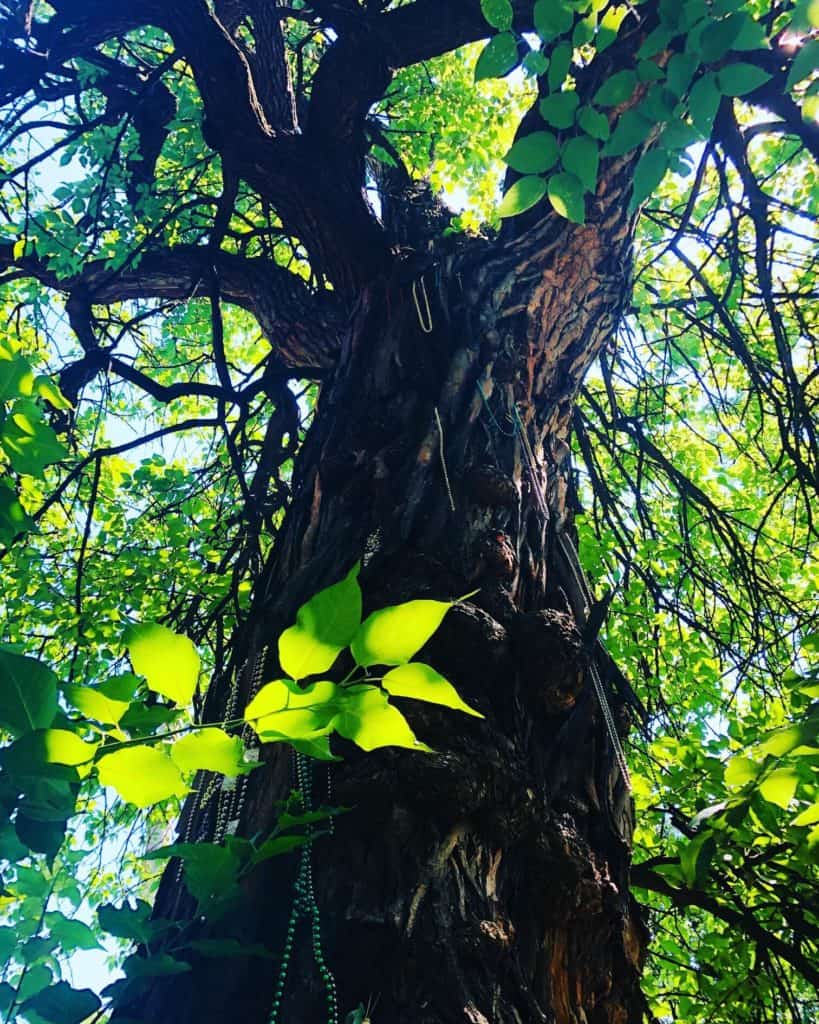
At the corner of South Sixth Street and Park looms a twisted and spooky tree that is often adorned with colorful beads, good-luck charms, gris gris bottles, voodoo dolls, and handwritten spells on small bits of parchment. According to legend, visitors leave these offerings to appease a coven of witches who used to gather under the branches of a majestic maple that once stood at the corner. When the crones learned of the city’s plan to chop down their beloved tree and use it as a maypole for the upcoming May Day festivities, they warned the people of Louisville there would be a terrible price to pay should their warning go ignored. But a woodsman came and chopped the tree down anyway, and the townsfolk prepared for their spring celebrations. The witches fled from the area and cursed the city, their last words warning the citizens to “beware eleventh month! Beware eleventh month!”
Exactly eleven months later, on March 27, 1890, a massive tornado devastated the city of Louisville and left more than a hundred dead bodies in its wake. The witches had taken their revenge. As the tornado roared out of town, past the corner where the lovely maple had stood, a bolt of lightning shot out from the funnel cloud and struck the stump. In a shower of sparks, flame, and smoke, today’s tree sprang up from the earth to replace the one stolen from the witches. Its gnarled trunk and dead branches serve as a reminder that it’s never a good idea to ignore witches. Since then, it has become a popular gathering place for not just witches, but practitioners of all religions.
The Pink Palace
1473 St. James Court
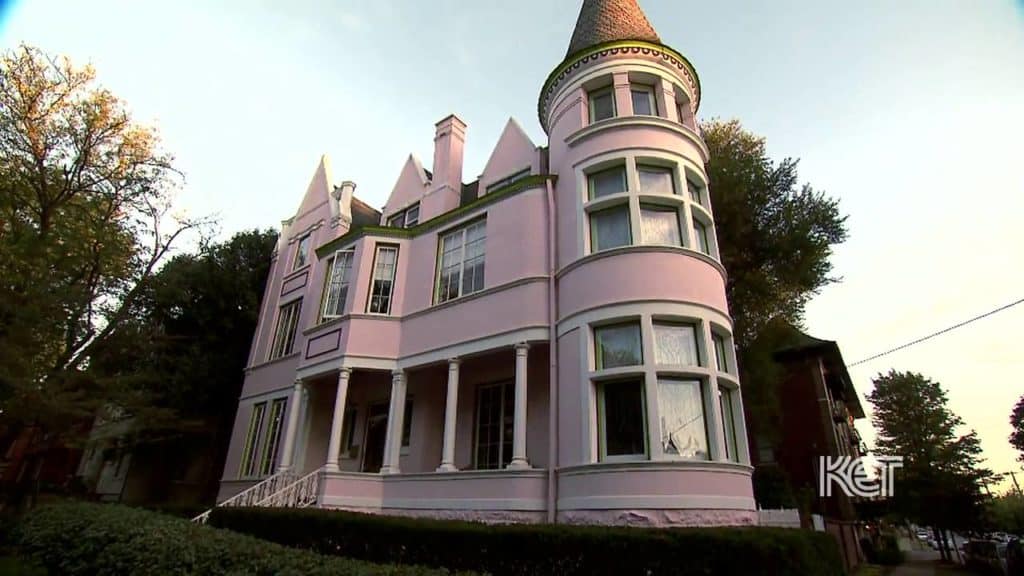
There are several beloved landmarks found on the quiet gas-lit spaces of St. James Court, the main residential enclave of Old Louisville. Built around 1891 at the intersection with pedestrian-only Belgravia Court, the Pink Palace has been the source of colorful gossip since its early days. An eccentric inventor lived there and he used to annoy his neighbors by noisily driving around in the neighborhood’s first automobile. Former residents insist that it is also haunted, by the spirit of a long-ago occupant who likes to hang around and keep a helpful watch over his successors.
Once a supposed house of ill repute, it received its colorful coat of pink paint after the Women’s Christian Temperance Union moved in and tried to whitewash the building’s sordid past—at least, that’s what many locals claim. One thing for certain is that this turreted masterpiece counts as one of the most recognizable houses in the Derby City today. It is a single-family residence, however, so don’t go knocking at the front door if you stop by to see it!

Millionaires Row
S. Third Street, 1100 to 1700 blocks
If you love grand old houses and beautiful architecture, check out the stretch of South Third Street known as the Derby City’s old “Millionaires Row.” The 1100 block to the 1700 block is lined with scores of limestone and brick residences that the bourbon barons, racetrack royalty, and the titans of tobacco called home in the late 1800s. Many blocks have remained largely unchanged for over a century and as you stroll the wide sidewalks, you’ll understand why visitors dubbed Louisville “the City of Beautiful Houses” back in the day.
Many of the grandest homes such as the Beaux Arts masterpiece known as the Samuel Grabfelder Mansion and the Samuel Culbertson Mansion, are found on the 1300 and 1400 blocks. You’ll also see a number of stunning churches, including the Gothic-inspired Walnut Street Baptist Church at the corner with St. Catherine, and the neoclassical First Church of Christ, Scientist, at the corner with West Ormsby. At the corner with Kentucky, you find Ollie’s Trolley, one of the last in a national chain of hamburger restaurants that originated in Louisville in the 1970s.